The mirror reflects a familiar Saturday evening ritual. A playlist hums softly in the background, fighting against the distant rattle of a London night bus, while a warm ring-light pools over your dressing table. You reach for a small, heavily branded pot of iridescent magic, the exact shade promising that ethereal, tear-streaked brilliance popularised by Hunter Schafer’s iconic television moments. It is the finishing touch, the signature of the modern night out.
You press a fingertip into the pot, lifting a constellation of silver and violet. It feels entirely innocent, like crushed fairy dust waiting to catch the low, moody lighting of a Soho basement club. Yet this microscopic starlight hides a profoundly jagged edge, one the beauty industry has been remarkably quiet about.
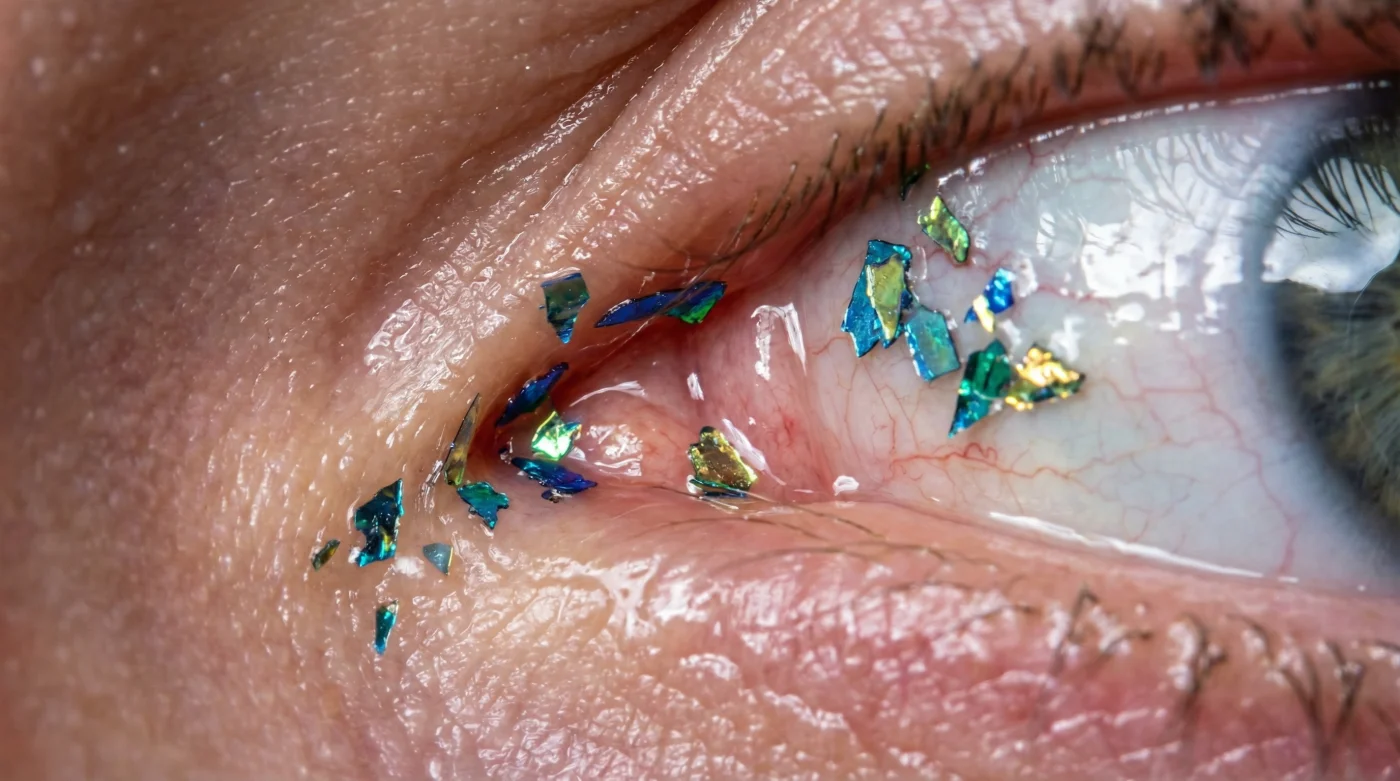
What appears to be a harmless sweep of glamour is, under a clinical lens, a storm of sharp, non-biodegradable plastics. The pursuit of that wet-look, crying-glitter eye has quietly precipitated a rising wave of severe medical emergencies across the UK, shifting the aftermath of a party from a mere hangover to a crisis of sight.
We are witnessing a stark, undeniable reality where the remnants of Friday night result in Monday morning surgical interventions. The glittering tear is no longer just a fading makeup trend; it is actively scarring delicate tissue, leaving permanent, vision-altering marks long after the festival season or the club lights fade.
The Shards in the Starlight
Think of the surface of your eye as a taut, wet silk drum. It is flawlessly smooth, designed to be swept cleanly by the velvet underside of your eyelid thousands of times a day. Now imagine dropping a handful of angular sand onto that silk and dragging it back and forth. The cosmetic industry frequently markets these shimmering particles as ‘eye safe’, a term that relies entirely on a lack of updated regulatory bodies rather than actual physiological compatibility.
The turning point comes when you realise that standard craft supplies and cheap cosmetic shimmer share nearly identical physical properties. They are precisely cut plastics, stamped by heavy machinery into microscopic squares or hexagons with sharp, unyielding corners that do not soften in fluid. What you thought was a soft pigment is, mechanically speaking, an abrasive weapon scraping against the cornea with every involuntary blink.
Dr Elias Thorne, a 48-year-old consultant ophthalmologist operating out of Moorfields Eye Hospital, has spent the last eighteen months documenting this escalating crisis. Last Tuesday, he spent forty-five meticulous minutes under a surgical microscope extracting a single, iridescent hexagonal flake from a young woman’s inflamed cornea. ‘It embeds itself like a tiny, immovable anchor,’ he noted quietly in his clinic. The particle, a cheap synthetic polyethylene terephthalate (PET) from a viral makeup palette heavily promoted on social media, had caused a micro-laceration so deep it required an emergency tissue graft to heal. The manufacturer had legally, but incredibly misleadingly, labelled the product as perfectly safe for the ocular area.
The Shimmer Spectrum: Where the Risk Lies
Not all that glitters carries the identical surgical risk. Protecting your vision without entirely sacrificing your aesthetic requires a clear, uncompromising breakdown of the materials you are currently trusting near your sight.
For the Festival Loyalist: You might be buying bulk tubs of chunky, iridescent flakes for heavy weekend application, secured with cheap aloe gels or eyelash glue. These mixed-size, non-biodegradable plastics are the absolute highest risk category. Because they are heavy and applied thickly, they migrate easily down the forehead as you sweat, settling directly onto the lash line and waiting for a single rub of the eye to fall inwards.
For the Subtle Enhancer: You perhaps prefer pressed glitter eyeshadows housed in expensive palettes. While the built-in binding agents keep the fallout lower during the initial application, the removal process is where the danger peaks. Scrubbing with standard cotton pads heavily forces these micro-plastics directly into the tear duct, where they can become trapped for weeks, causing chronic inflammation.
- Alexa Demie makeup routines are triggering contact dermatitis in teenage skin.
- Castor oil creates an optical illusion without actually stimulating lash growth.
- Dry shampoo application at night completely eliminates morning scalp grease buildup.
- Electrolyte powders fix chronic winter skin flaking faster than heavy creams.
- LED face masks completely fail over thick night cream applications.
- Cream bronzer application requires warm fingertips instead of damp beauty blenders.
- Liquid eyeliner ages hooded eyes instantly with the traditional stretch technique.
- Apple cider vinegar destroys your scalp microbiome without this dilution ratio.
- Micellar water residue is causing stubborn cystic acne in women over forty.
- Dyson Airwrap owners are causing permanent heat damage using this attachment.
For the Conscious Creator: You are actively looking toward the newer, biodegradable cellulose alternatives, hoping to protect the oceans and your eyes simultaneously. While visually softer, even plant-based particles can cause mechanical scratching if they are cut too large. The base material absolutely matters, but the physical shape and sheer size are what ultimately dictate your safety.
The Protocol for Safe Removal and Replacement
Protecting your vision means fundamentally changing how you approach the end of the evening. It is about gently dissolving the bond, rather than aggressively dragging the particle across your face.
The absolute worst mistake is the rapid, exhausted swipe of a dry cleansing wipe at two in the morning. Instead, heavily saturate the area to create a thick protective slip. You want to lift the particles off the skin as if lightly skimming autumn leaves from the surface of a still pond.
- Soak a reusable cotton pad entirely in a heavy, oil-based cleansing balm or pure squalane oil.
- Press the soaked pad gently over the closed eyelid and hold it completely still for thirty full seconds. Breathe softly. Do not rub or twist.
- Slide the pad slowly downwards, moving from the brow bone toward the cheekbone in one single, deliberate motion.
- Use a clean, damp cotton swab dipped in micellar water to precisely pick up any stray particles lingering near the waterline.
- Rinse the entire face with lukewarm water, flushing the eyes gently with sterile saline if you feel even a whisper of grit.
Your Tactical Toolkit: Swap the dangerous PET plastics for synthetic fluorphlogopite (often listed as synthetic mica). This lab-grown marvel provides an intensely high-shine, wet-look finish without the jagged edges, washing away effortlessly without ever requiring a surgical microscope to undo the damage.
Seeing Beyond the Reflection
The core allure of the Euphoria-inspired aesthetic was always about raw, unfiltered emotion painted directly onto the skin. It was a beautiful, necessary rebellion against the matte, airbrushed perfection of previous decades. Yet, true, lasting care for your body requires looking past the immediate visual gratification of a trending look.
The temporary magic of catching the light in a crowded, pulsing room quickly loses its charm when weighed against the absolute clarity of your sight. Protecting your physical wellbeing, especially the delicate mechanics of your eyes, is the ultimate and most enduring form of self-respect.
By retiring the jagged, unethical plastics of the past, you are not giving up on personal creativity or night-time glamour. You are simply refusing to pay a permanent, physical price for a passing trend. The truest, most captivating glow always comes from eyes that are bright, healthy, and entirely intact.
‘The cornea is exquisitely sensitive, a masterpiece of human evolution; treating it as a canvas for industrial plastics is a tragedy we see unfold daily in the clinic.’ – Dr Elias Thorne
| Key Point | Detail | Added Value for the Reader |
|---|---|---|
| PET Glitter | Sharp, non-biodegradable synthetic plastic flakes commonly found in cheap palettes. | Helps you identify the highest-risk products to bin immediately to prevent permanent scratching. |
| Cellulose Glitter | Plant-based alternatives with softer edges, but still poses a minor friction risk. | Offers a safer, eco-conscious middle ground for casual wear, provided you remove it carefully. |
| Synthetic Mica | Lab-grown fluorphlogopite that dissolves smoothly without retaining sharp corners. | Gives you the ultimate wet-look shine with zero scratching risk, ensuring total peace of mind. |
Frequently Asked Questions
Can scratched corneas heal entirely on their own?
Minor surface abrasions often heal within a few days with proper rest and prescribed lubricating drops. However, deep lacerations caused by embedded plastics require immediate medical intervention and can leave permanent, vision-blurring scars.
How do I definitively know if my makeup contains PET plastic?
Check the ingredient list on the back of the packaging. Look for ‘Polyethylene Terephthalate’. If you see this listed in an eyeshadow or face pigment, it is standard plastic glitter and carries a high risk of scratching.
Is glitter labelled ‘cosmetic grade’ completely safe for my eyes?
Not necessarily. ‘Cosmetic grade’ often just means the dyes used are non-toxic and the particles are cut slightly smaller or rounded. Mechanically, they can still act as an abrasive if they become trapped under the eyelid.
What is the very first thing I should do if glitter gets in my eye?
Do not rub your eye under any circumstances. Blink rapidly to encourage natural tears, then flush the eye generously with sterile saline solution or clean, lukewarm water until the sensation stops. If pain persists, go to an eye hospital.
Are liquid glitter eyeshadows safer than loose glitter pots?
Generally, yes. The liquid or gel base acts as an adhesive, significantly reducing the chance of dry fallout migrating into the eye during wear. However, extreme care is still required during the removal process.