Morning light hits the bathroom mirror, catching the subtle silver gleam of your liquid eyeliner pen. You shake it gently, hearing the tiny ball bearing inside click back and forth, preparing the dense, carbon-black ink for application.
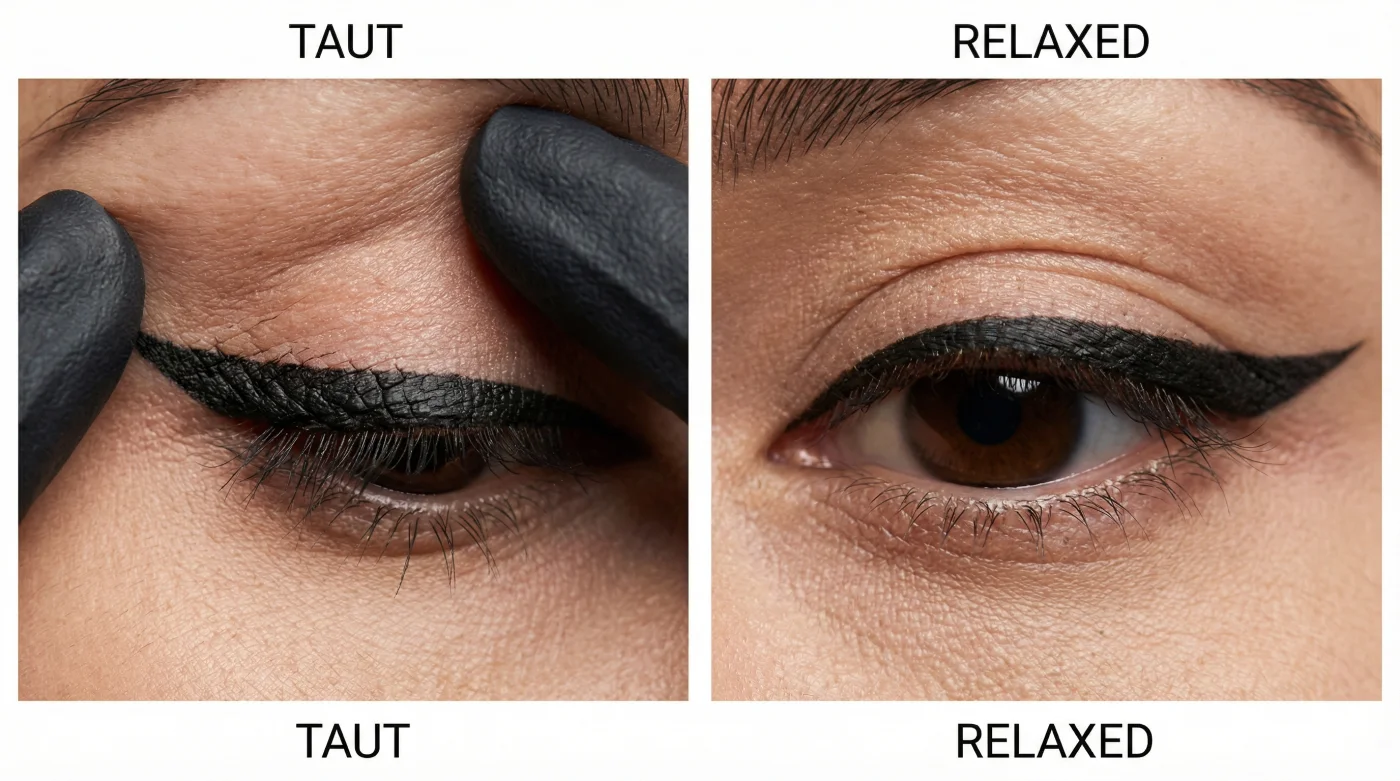
Since your teenage years, muscle memory has dictated the next move. You stretch the outer corner of your eyelid, pulling the skin taut towards your temple to create a perfectly flat, smooth canvas for the brush tip.
But as the delicate skin around our eyes changes and softens with time, this ingrained habit becomes counterproductive. When you let go, that supposedly perfect line crumples into a jagged, heavy shape that pulls the eye downwards, entirely defeating the purpose of makeup meant to lift and brighten.
The truth about liquid eyeliner on mature, hooded lids isn’t that you need a steadier hand or an expensive formula. It requires a radical unlearning process, abandoning the tension and embracing gravity to map a shape that flatters your resting face.
The Illusion of Tension
Think of traditional eyeliner application like tailoring a dress on a plastic mannequin. It looks pristine in a static, artificial state, but the moment it meets a real, breathing human, the fabric bunches and pulls. Your eyelid acts similarly. By stretching the skin, you are mapping a line for an eye shape that simply does not exist when your face is relaxed.
Instead of fighting the natural drape, work with the folds. The secret lies in looking dead straight into the mirror, eyes fully open and relaxed. You aren’t drawing a continuous line; you are drafting a clever optical illusion.
Sarah, a 52-year-old portrait photographer from Bath, spent decades executing a razor-sharp flick with her liquid liner. Yet, as her brow bone lowered slightly in her late forties, she noticed her trademark look was suddenly casting a shadow, making her appear constantly fatigued. Frustrated, she stopped pulling the skin and began marking her flick while staring blankly ahead. By drawing straight across the natural fold of her hooded lid, the resulting shape looked like a disjointed step when her eyes were closed, but morphed into a perfectly crisp, upward-sweeping wing the moment she opened them.
Adapting the Wing for Your Lid Type
Not all hooded eyes age the same way. The architecture of your brow bone and the exact point where your lid folds dictate how you should navigate the delicate skin around the outer corners.
For the deep-set hood, the brow bone sits heavily over the mobile lid. Forget trying to line the entire lash line, which will only transfer ink onto the upper crease. Keep the liquid formula strictly to the outer third of the eye, using it solely to construct the uplifting flick.
Then there is the asymmetrical fold. It is entirely normal for one eye to droop slightly more than the other as we grow older. Rather than attempting to draw identical shapes, focus on identical endpoints. Mark the outer tip of your wing on both sides first, then connect them back to the lash line, adapting the angle to suit the specific fold of each individual eye.
The Relaxed Gaze Technique
Executing this method feels strange at first, almost like writing with your non-dominant hand. Resist the urge to touch your face or tilt your chin up, as any movement alters the canvas.
Keep your breathing steady and your facial muscles slack. To master the optical illusion, you need to rely on a few mindful, precise movements rather than sweeping, continuous strokes.
- Position yourself squarely in front of a mirror, ensuring your chin is parallel to the floor.
- Keep your eyes open and completely relaxed, staring directly ahead at your own pupils.
- Using the tip of your eyeliner, stamp a tiny dot where you want the wing to end.
- Draw a straight line from that dot directly towards your lash line, allowing the pen to glide right over the natural crease.
- Fill in any gaps only on the outer edge, leaving the inner portion of the eyelid entirely bare.
Your tactical toolkit requires a wall-mounted mirror at eye level to prevent you from looking down. You also need direct, natural daylight to avoid false shadows, and a brush-tip liquid liner, which flexes without catching.
Seeing the Face You Have
Letting go of the taut pull technique is about more than just preventing smudged makeup. It is a quiet rebellion against the rigid, unyielding beauty rules we absorbed in our youth. By accepting the way our skin naturally falls and folds, we stop trying to force our faces into outdated shapes.
You begin to treat your morning routine less like a corrective chore and more like a gentle, creative collaboration with yourself. Embracing the optical illusion gives you back the sharp, bright-eyed lift you remember, achieved not through tension, but through clever, relaxed acceptance.
The perfect wing on a mature eyelid is born from understanding the canvas as it lives and breathes, not as it is pinned down.
| Key Point | Detail | Added Value for the Reader |
|---|---|---|
| The Taut Pull | Stretches skin artificially | Results in a hooked, downward dragging wing upon release. |
| The Relaxed Gaze | Maps the eye naturally | Creates a sharp, lifting optical illusion tailored to your face. |
| Brush-tip Liner | Flexes over textured skin | Prevents skipping and bleeding on delicate, mature lids. |
Frequently Asked Questions
1. Why does my liquid liner always bleed into fine lines?
Liquid formulas can travel through dry skin. Ensure your eye area is hydrated, but completely oil-free before application.
2. Can I still line my inner corners?
With hooded eyes, inner corner liner often closes the eye off. Stick to the outer third for maximum lift.
3. What if my hand shakes while looking straight ahead?
Anchor your elbow firmly on a table and rest your pinky finger lightly against your cheekbone for stability.
4. Should I use black or brown eyeliner over fifty?
Brown offers a softer, more forgiving definition that brightens the whites of the eyes without the harsh contrast of stark black.
5. How do I fix a mistake without ruining my base?
Let the liquid dry completely, then gently flick it away with a dry, clean spoolie brush rather than smudging it with makeup remover.