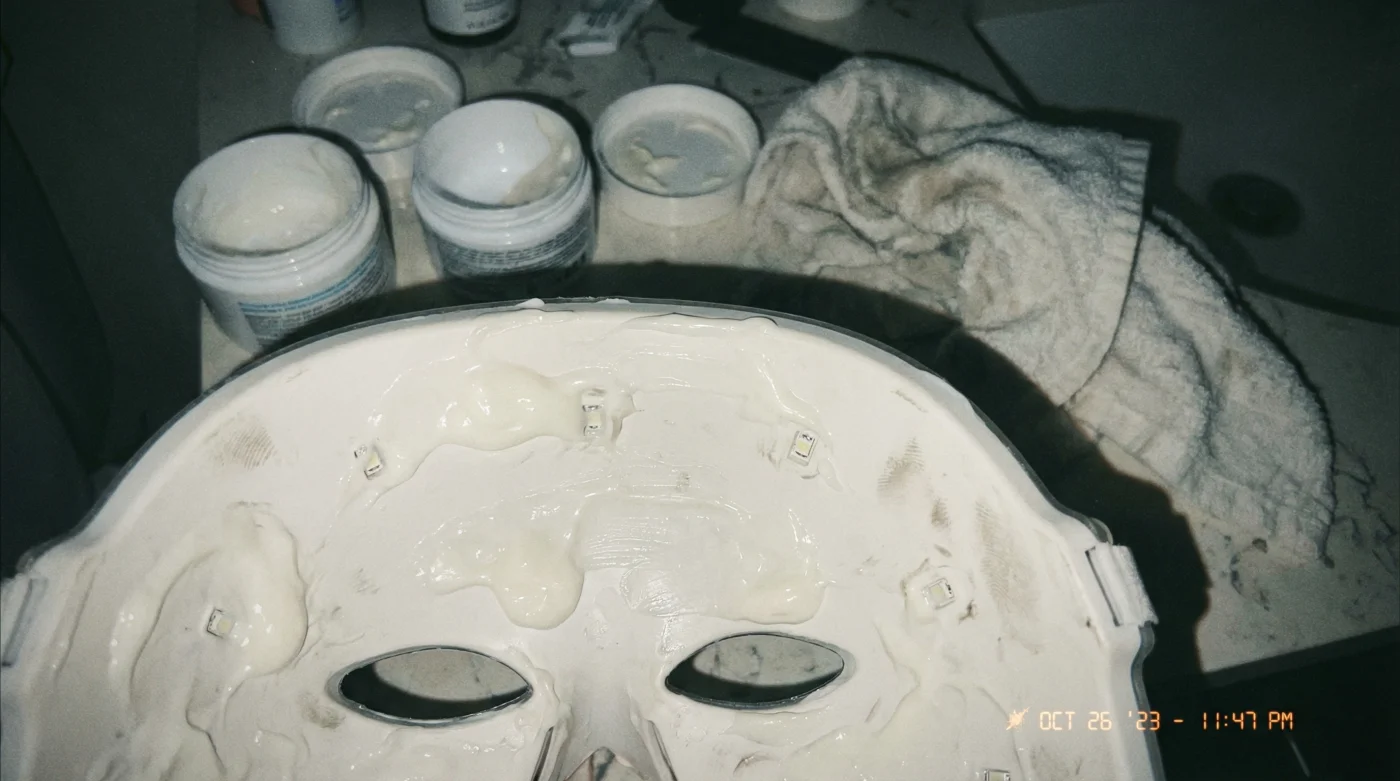
Picture a quiet Tuesday evening in your bathroom. The mirror is slightly steamed from a hot flannel, and you are painstakingly massaging a generous layer of that fifty-pound peptide night cream into your cheeks. You switch on your LED face mask, settling back onto the sofa while bathing in an eerie crimson glow. It feels like the pinnacle of self-care.
But beneath that glowing silicone shield, a microscopic rebellion is taking place. The thick emollients and botanical butters you just applied are acting as a physical barrier. Instead of sinking deep into your cellular structure, the light simply bounces off, entirely blocked by the dense layer of hydration.
We have been conditioned to believe that wrapping our faces in light while covered in heavy creams somehow pushes the active ingredients deeper. It feels wonderfully indulgent, mimicking the heavy layering techniques seen in glossy lifestyle magazines. Yet, this well-meaning habit is quietly sabotaging the entire process.
The reality of light therapy is remarkably humble. By stripping away the expensive layers and trusting the raw technology, you are actually giving your skin a true biological advantage, allowing the exact nanometre wavelengths to finally reach your collagen-producing cells.
Shining A Torch Through Frosted Glass
Think of your skin’s surface as a highly sophisticated sponge. When you coat it in night creams, ceramides, or sleeping masks, you are essentially sealing that sponge with a thick layer of wax. If you were to shine a torch through a clear window, the light cuts straight through to illuminate the room. Smear that glass in butter, and the beam scatters in every direction.
Light emitting diodes work on precise, delicate mathematics. Red light typically hovers around 633 nanometres, designed to sink just beneath the epidermis to trigger fibroblast activity. When it hits a wall of emulsifiers and synthetic silicones, the wavelength refracts and fractures, losing its ability to stimulate anything at all.
Consider the work of Dr Rosalind Hayes, a 54-year-old dermal phototherapy technician based in a small clinical lab in Bath. After noticing a sudden drop in results among her home-care clients, she placed slides coated in standard night creams under her commercial LED arrays. She found that even a sheer layer of everyday moisturiser reduced light penetration by up to seventy percent. The cream wasn’t being pushed in; it was acting as a microscopic mirror, reflecting the therapeutic light straight back at the bulbs.
Navigating The Bare-Faced Reality
Shifting to a completely bare face might feel incredibly unnatural, particularly if your evening wind-down usually involves immediate, comforting hydration. The trick is to categorise your routine by viscosity, rather than blindly following the traditional cleanse-tone-moisturise rhythm.
For the Chronically Dehydrated
If the thought of sitting with a naked, freshly washed face makes your skin feel painfully tight, you do have a slight concession. A purely aqueous, water-based essence—one completely devoid of oils or milky emulsifiers—can be patted onto the skin beforehand. It absorbs immediately, leaving no surface film to interfere with the light.
For the Active Ingredient Devotee
Those relying on strong retinoids, exfoliating acids, or potent vitamin C serums face a different hurdle. These compounds can occasionally provoke a slight photosensitivity. For this group, patience yields the best results. Keep the active ingredients firmly in the bathroom cabinet until the mask goes back in its box.
The Uncluttered Evening Protocol
Adjusting your approach does not require buying anything new. In fact, it saves you from wasting your most expensive formulas. It is simply about resetting the timeline of your evening ritual to honour the science of light.
Rather than rushing through the steps, treat the LED session as a distinctly separate event from your topical skincare. This separation of powers ensures both the technology and the creams operate at maximum efficiency.
Follow this stripped-back method to ensure maximum light absorption:
- Cleanse your face thoroughly, ensuring all remnants of daily SPF, makeup, and pollution are entirely dissolved.
- Pat the skin completely dry with a clean towel, breathing through the temptation to immediately reach for a serum.
- Secure the mask over your bare face, allowing the raw light to bathe the unhindered skin for the recommended ten minutes.
- Remove the device, and only then proceed with your serums, moisturisers, and thick nighttime sealants.
Your tactical toolkit here is wonderfully minimal. You only need a freshly cleansed face and your device fully charged, removing the chaotic guesswork from the equation entirely.
Finding Peace In The Minimal
Letting go of the layering myth is strangely liberating. We are constantly sold the idea that more is fundamentally better—that blending every gadget and cream into one simultaneous super-routine will fast-track our results. Yet, genuine efficacy often hides in knowing when to step back.
By trusting the bare skin beneath the mask, you are not just correcting a minor technical error. You are reclaiming your own authority over your routine, allowing a highly specific, proven technology to do exactly what it was designed to do, without interference.
The truest luxury of a home spa treatment isn’t found in how many expensive layers you can stack on your face at once. It is found in the quiet confidence of knowing exactly how things work, letting the light reach the depths it needs to, and saving that beautiful, thick night cream for the very end.
By stripping back the heavy creams during light therapy, you aren’t just improving cellular resonance; you are saving pounds on wasted skincare that was only ever acting as a barrier.
| Key Point | Detail | Added Value for the Reader |
|---|---|---|
| Bare Skin Permeability | Thick creams refract 633nm red light away from the skin. | Ensures your expensive mask actually reaches the collagen matrix. |
| Product Waste Reduction | Creams applied under masks are neither absorbed nor effective. | Saves you money by reserving premium creams for post-treatment. |
| Water-Based Exception | Purely aqueous toners leave no reflective film. | Provides comfort for dry skin without compromising the light therapy. |
Frequently Asked Questions
Can I use hyaluronic acid under my LED mask? If it is a purely water-based serum without any added oils, silicones, or thickeners, yes. If it feels tacky or thick, wait until after the light session.
Will bare skin dry out during the ten-minute treatment? It may feel slightly tight initially, but the brief waiting period will not damage your lipid barrier. You can immediately flood the skin with moisture afterwards.
Does the heat from the mask help creams absorb? Home LED masks do not generate enough thermal energy to melt or push heavy creams into the pores. The light relies entirely on unhindered optical pathways.
What about applying retinol before the mask? Retinoids can cause slight photosensitivity. It is much safer and more effective to apply strong active ingredients after you have finished your light therapy.
How clean does my skin need to be? Thoroughly cleansed. Even a residual layer of daytime SPF contains microscopic reflectors like zinc or titanium dioxide, which will block the red light.