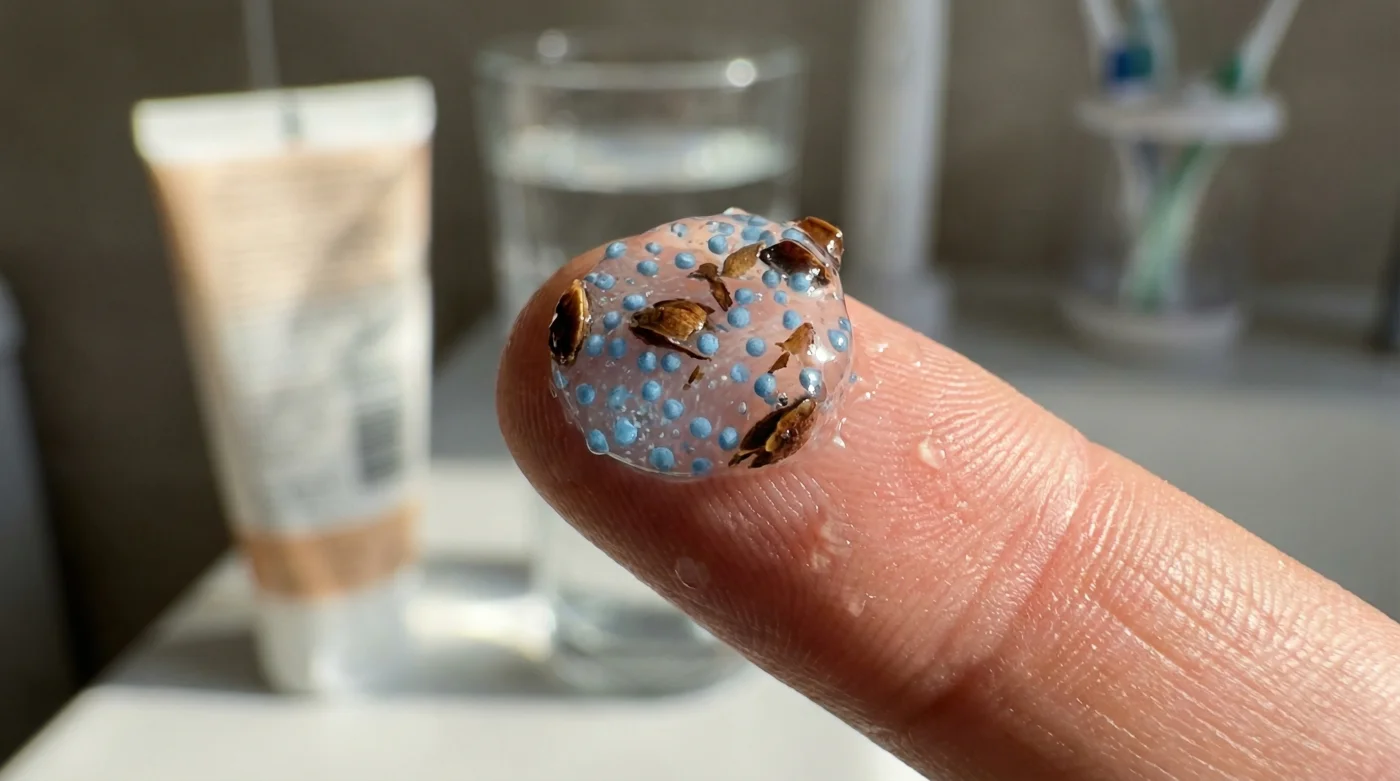
You are standing in the brightly lit aisles of your local high street chemist, rainwater dripping from your coat, reaching for the familiar frosted tube of your favourite face scrub. You know exactly how it feels against your skin. The gritty, deeply satisfying friction that seemingly erases the grey film of a long Tuesday, leaving a polished, breathless surface behind. For years, that perfectly smooth, entirely uniform grit felt like a modern luxury.
Tiny scrubbing beads washing away dullness with mechanical precision. But beneath the foaming suds, those little uniform spheres were hiding a stubborn reality. They never broke down. They washed down the plughole, slipped effortlessly through the local water treatment works, and settled deep into the soil and the riverbeds. Every time you washed your face, thousands of these indestructible spheres flowed out to sea, accumulating on British coastlines and entering the food chain.
Now, the formulas you know by heart are vanishing from the shelves. The latest European Union regulations, which continue to dictate the manufacturing standards for the British market, have drawn an uncompromising line in the sand regarding environmental protection. Your beloved exfoliator has not been quietly discontinued; it is undergoing a radical, organic metamorphosis.
Synthetic polymers are completely banned in wash-off cosmetics across these regulated markets. The Polyethylene and Polypropylene that once filled your bathroom cabinet are being entirely phased out, replaced by natural alternatives that demand a slightly different approach.
The Polyester Problem and the Linen Solution
For the better part of two decades, the beauty industry relied heavily on Polyethylene (PE) and Polymethyl methacrylate (PMMA). These are the names of the microscopic plastics that gave your morning scrub its signature slip. They were phenomenally cheap to produce, perfectly round, and rarely scratched the skin. But relying on plastic to clear your pores is rather like wearing a polyester shirt in the middle of an August heatwave. It does the job of covering you up, but it does not breathe, it does not interact with your body, and it leaves a suffocating residue.
Embrace the natural irregularity of the organic alternatives currently flooding the market. We have been conditioned to view perfectly spherical beads as superior. Yet, this mundane flaw of natural exfoliants—their slightly irregular, uneven shapes—is actually a major advantage.
Imagine sweeping a completely smooth marble across a dusty floor; it pushes the debris around without collecting much. Now imagine using a stiff bristle brush. The varied microscopic edges of crushed walnut shells, bamboo silica, and oat flour act like bespoke polishing tools rather than blunt instruments. They grip dead cells and lipid buildup with far greater efficacy.
Finding the melting point of these natural substitutes became the obsession of Dr Eleanor Vance, a forty-eight-year-old formulation chemist based just outside Leeds. She spent the last eighteen months sweating over heavy mixing vats, initially trying to blindly mimic the artificial slip of PMMA. After countless failed batches, she stopped trying to force nature to behave like a synthetic plastic. She discovered that by letting jojoba esters warm against the skin, they partially dissolved, conditioning the acid mantle while gently buffering away the dead cells.
Reformulating Your Routine by Skin Temperament
As you navigate this newly reformulated landscape, you will notice the textures have profoundly changed. You must adapt your choices to the raw ingredients now sitting on the labels. If your skin turns red at a brisk wind or you suffer from tight, dry patches, you must avoid the harder stone-based scrubs.
Respecting your skin barrier means seeking out formulas heavy in jojoba esters or finely milled oat flour. These melt upon contact with your body heat, offering a soft buffing action that leaves a lipid-rich film behind. You are not blasting your face with hard plastics; you are feeding it.
- Micellar water residue is causing stubborn cystic acne in women over forty.
- SPF50 moisturisers provide half the stated protection after two hours outdoors.
- Dyson Airwrap owners are causing permanent heat damage using this attachment.
- Vitamin C drip therapy clinics are hiding this crucial absorption limitation.
- Hyaluronic acid is accelerating moisture loss in mature British winter skin.
Balancing your combination skin with natural ingredients allows for targeted treatment without overwhelming your complexion. You might find that bamboo silica is perfect for the nose and chin, but too active for the rest of the face. Look for hybrid formulas that blend finely milled cellulose beads with a base of rich glycerin or sweet almond oil. The cellulose provides the necessary grit for congestion, while the oil base buffers the friction over your drier areas.
Targeting rough body patches around the ankles or the backs of the arms requires heavy-duty friction. Crushed olive stones and walnut shells, when finely milled, offer an aggressive but wholly biodegradable sweep that tackles keratosis pilaris brilliantly.
Adapting to the New Textures
Gently massage the compound into damp skin using the lightest possible pressure. Think of it as smoothing out a fragile piece of wet silk, allowing the grit to lightly dust the surface.
- Dispense a ten-pence sized amount of the scrub into wet palms.
- Press the product onto a damp face, rather than rubbing it directly into dry skin.
- Use small, circular motions with just the pads of your ring fingers.
- Allow the product to sit for sixty seconds before rinsing, giving any natural enzymes a chance to work.
Your Tactical Toolkit for this transition requires water at a lukewarm temperature. Hot water exacerbates friction and strips oils, making the natural exfoliants feel harsher than they are. Keep your application strictly timed to no more than two minutes.
Washing Away the Guilt
Knowing your beauty routine ends definitively at the edge of your bathroom sink brings a deep sense of peace. We spend so much of our lives trying to control the uncontrollable, worrying about the invisible traces we leave behind in the environment.
You are no longer trading a few moments of smooth skin for a legacy of microplastics in the water table. The tactile sensation of washing your face transforms from a mindless habit into a highly mindful interaction.
Working with raw ingredients that grew from the earth and will harmlessly return to it changes the atmosphere of your morning. It makes the simple act of cleansing feel remarkably whole, grounded, and intensely personal.
The true art of skincare is learning to work with nature’s textures rather than forcing a synthetic mimicry onto the skin.
| Key Point | Detail | Added Value for the Reader |
|---|---|---|
| Polymer Ban | Removal of PE, PP, and PMMA from wash-off cosmetics. | Protects local waterways while forcing brands to use higher-quality ingredients. |
| Irregular Shapes | Natural exfoliants have varied microscopic edges. | Provides a superior, bespoke polish that grips dead skin better than smooth plastic. |
| Temperature Sensitivity | Jojoba esters and oat flour melt at body temperature. | Conditions the skin barrier while exfoliating, preventing the tight, dry feeling post-wash. |
Frequently Asked Questions
Will natural exfoliants cause micro-tears in my skin? Modern milling techniques ensure ingredients like bamboo silica and crushed shells are finely ground to remove sharp edges, making them entirely safe when applied with light pressure.
Why does my new scrub feel less slippery? Synthetic plastics provided an artificial glide. Natural alternatives rely on the formula’s base oils for slip, meaning you need to use more water and less physical force.
Are cellulose beads truly biodegradable? Yes, cellulose is a plant-based material that dissolves naturally in water systems without leaving harmful residues behind.
Can I still use up my old plastic-based scrubs? While you can finish what you own, wiping the product off with a muslin cloth and throwing it in the bin prevents the beads from entering the water system.
How often should I use these new organic scrubs? Because natural edges are slightly more effective at gripping dead skin, reduce your usage to once or twice a week to maintain a healthy barrier.